

A.S.D. Equestre Kappa is an equestrian club between Rome and Fiumicino with more than 35 years of history: riding school, pony school, livery, full and half part-loans. It is also where I built a riding school management system that the office now uses every day, and that I now offer to other clubs too.
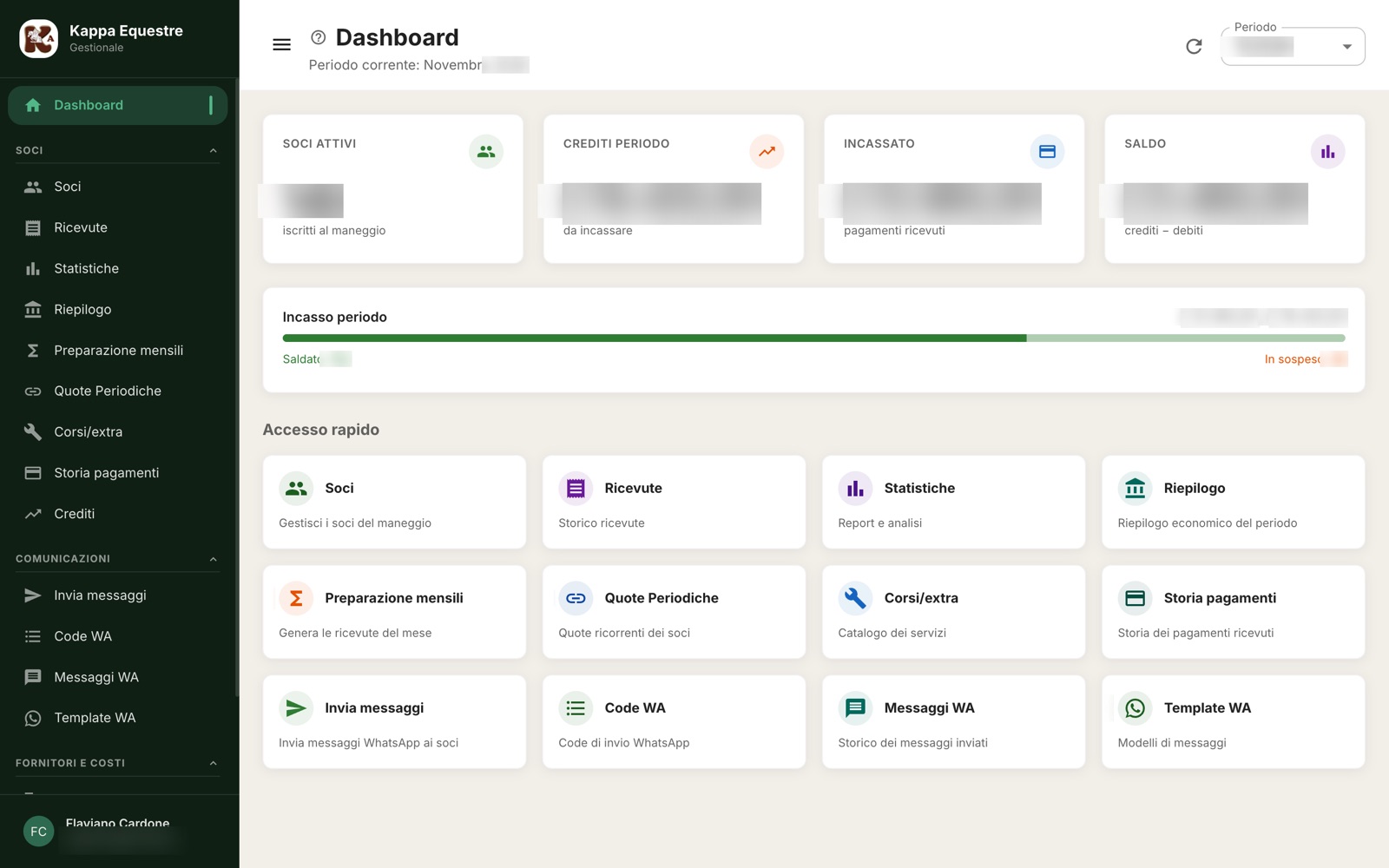
This is how it was born, how I rewrote it from scratch without ever stopping the office, and what I learned about software for small organisations.
The problem: the end-of-month accounts
In a riding school every member has their own mix: livery for the horse, a half part-loan, a child’s lessons, an extra for transport to a show. Every month someone has to work out who owes what, collect it, issue the receipt and, the least pleasant part, chase whoever has not paid.
Spreadsheets and messages from a personal phone get it done, but with effort: mistakes cost money and, worse, relationships with members.
The first version: it worked, but it was too complex
The first version was born in December 2023. It did its job, but I had built it like an enterprise system: micro-frontends, separate services, shared libraries. In all there were about twenty repositories, each with its own version and release. For a club with a small office, that architecture was out of proportion: every change touched several projects, and releasing meant coordinating everything by hand.
The rewrite: contract first, code second
In April 2026 I decided to rewrite it as a single monorepo. Before writing code I wrote the documents: an inventory of what existed, the API map and above all a compatibility matrix, meaning what could not change.
- API addresses stay the same, so the switch can happen one piece at a time.
- Login stays the same: same users, same passwords, same Keycloak.
- Credits, charges, receipts and costs keep exactly the same meaning.
- PDFs must contain the same data the office is used to reading.
In software for a small organisation the technology can change as much as you like, but the numbers cannot. If a member’s balance is off by one euro at the end of the month, you have lost the office’s trust, and you have lost it for good.
The accounts compared to the cent
So I wrote a read-only script that reads the same period from the production and staging databases, repeats the v2 statistics calculation and compares the results line by line. A module was ready only when the numbers matched.
v2 went into staging alongside v1 on a different address, while the office kept working on the old one. In June 2026 came the switch: same login screen, same data, new software.
| Before | After | |
|---|---|---|
| Repositories | about twenty | one (monorepo) |
| Release | coordinated by hand | automatic: main goes to staging, a tag goes to production |
| Services | scattered micro-frontends and services | one web app and seven small TypeScript services |
| Releases, June to November 2026 | more than 40 |
The things that really matter
Once the architecture was sorted, the real work was listening to the office. Almost none of the most appreciated features are technical:
- The monthly statement on WhatsApp. The office sends each member their statement or receipt as a PDF, with official WhatsApp Business templates, and sees the outcome of every message. Members with nothing to pay get nothing: obvious, but it was not before.
- Errors in plain language. When a message fails, WhatsApp answers with codes like 63016 or 131047. Now the office reads “the member has not messaged the club in the last 24 hours”, not a number.
- Unpaid balances for the right period. The month only, year to date or all time: three different questions, three different answers.
- Guided enrolment. New member, services, monthly statement, payment, in one flow.
- On the phone. It installs like an app, because in a riding school the office is often out in the arena, not at a desk.
- Filters that stick. Open a member, go back to the list and your search is where you left it. A small thing, but it happens dozens of times a day.
What I learned
- For a small organisation operational simplicity beats architectural elegance: one monorepo and one pipeline beat twenty well-made repositories.
- A rewrite is done with real data and compared accounts, not on trust.
- The features that matter are written by the people who use it. Many of the releases started with a sentence from the office like “it would be handy if…”.
- Software made for a real club works for others too: fees, part-loans and unpaid balances are the same everywhere.
Do you run a riding school or an equestrian club? The software born at Equestre Kappa is available for your club too. I will show you how it works in half an hour.
Leave a Reply